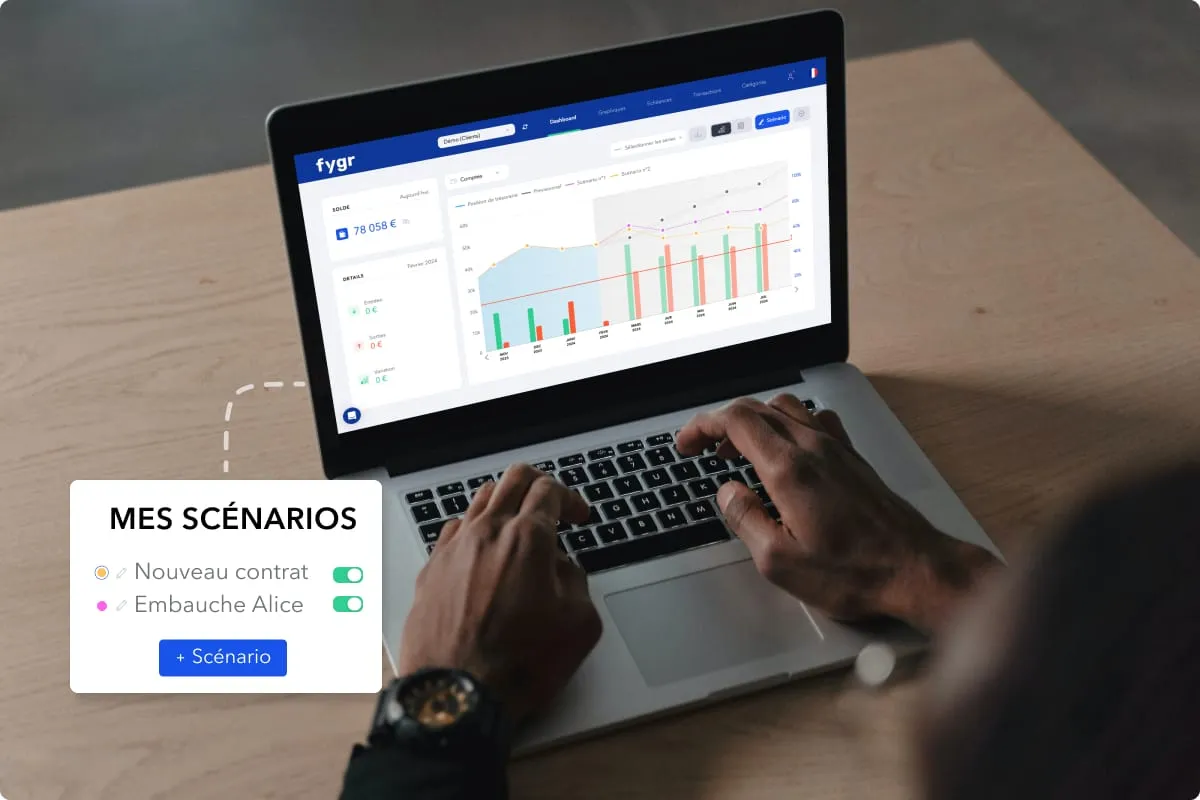
Optimizing cash flow management for a training organization

Training organizations face very specific cash flow management challenges. With multiple payment sources (direct payments from individuals or via CPF accounts), working capital management is particularly complex. In this article, we will look at how to optimize cash flow management and how a tool such as Fygr could help you do so.

Training organizations: key points to remember about cash management

Cash management is a key strategic issue for training organizations, whose business model relies on multiple funding sources, irregular training cycles, and heavy dependence on public funding. Tensions arise from a structural imbalance between permanent fixed costs, cash flow delays, and uncertainty about future funding:
Multiplicity and complexity of funding sources (CPF, OPCO, grants, private funding)
Marked seasonality of training cycles alternating between periods of intense activity and quiet phases
Significant discrepancies between expenses incurred and cash receipts (salaries, premises, teaching resources)
High dependence on public policies and reforms affecting financial flows
Fygr enables training organizations to secure their cash flow, make their financial projections more reliable, and regain control of their working capital, despite the administrative complexity of the sector.


The specific cash flow challenges for training organizations

Why is cash management particularly difficult for training organizations? We have identified three major issues.

Multiplicity and complexity of funding sources

In the training and education sector, organizations must simultaneously manage multiple sources of funding: public subsidies, private funding, OPCOs, individual and professional training funds.

This multiplicity creates considerable administrative and financial complexity. Each source of funding has its own rules, payment schedules, and specific conditions, generating constant time lags between expenses incurred and expected revenues.

Managing these cash flows becomes a real obstacle course, where the slightest error can compromise the organization's financial stability.

Seasonality and altered training cycles

The training sector is highly seasonal, with periods of intense activity alternating with quiet periods.

The start of the school year, continuing education sessions, and professional development programs follow specific cycles that structurally weaken cash flow.

Organizations must bear significant fixed costs (staff, premises, equipment) while revenues are discontinuous and sometimes uncertain. This irregular financial situation requires constant vigilance and a permanent capacity to adapt in order to maintain a fragile economic balance.

Dependence on public policy and economic change

Training organizations are particularly vulnerable to changes in public policy and economic shifts.

Reforms in vocational training, regulatory changes, and transformations in the labor market can instantly alter funding conditions and training arrangements.

This structural instability creates permanent uncertainty about future resources. Organizations must constantly anticipate, adapt, and diversify their sources of income, while maintaining a sufficient level of investment to remain competitive in a constantly changing environment.
BEST PRACTICES

How to effectively manage the cash flow of a training organization

Anticipating and managing financial seasonality

Vocational and continuing education involves complex and highly variable financial cycles. Organizations must develop a proactive approach to cash flow management by accurately mapping out their critical periods. This strategy involves meticulously identifying times of the year when cash flow will be tight, particularly during training off-seasons or transitions between different programs. By anticipating these cycles, managers can build up financial reserves, negotiate appropriate lines of credit, and adjust their educational investments. A detailed understanding of these dynamics makes it possible to transform potential financial fragility into a strategic opportunity for development.

Diversify and secure sources of funding

The financial resilience of a training organization depends on its ability to diversify and secure its sources of income. This approach requires building a varied funding ecosystem, combining public subsidies, private funding, corporate contributions, and vocational training funds. The key lies in the ability to develop sustainable strategic partnerships, respond effectively to calls for projects, and create attractive programs for different funders. This diversification significantly reduces financial risks and provides multi-year visibility of potential resources, making the organization less dependent on a single source of funding.

Streamline administrative and financial monitoring

The administrative management of training organizations requires absolute rigor and traceability. The implementation of standardized processes for tracking agreements, training hours, supporting documents, and reimbursements is crucial. This streamlining involves the systematic centralization of documents, the precise classification of different types of funding, and secure digital archiving. The aim is to simplify controls, reduce the risk of errors, and facilitate the production of detailed reports for the various funding bodies. Such an approach not only improves administrative efficiency but also enhances the organization's credibility and transparency with its institutional and financial partners.
CHOOSE FYGR

Why use Fygr for a training organization?

The solution for managing your training organization: Fygr. Fygr is an optimal cash management software for managing your training organization's cash flow. Let's take a look at how in the rest of this article.
GOOD REASON #1

Financial management of training flows

Simplify the management of your multi-partner financial resources
Automatic consolidation of receipts by training type
Dynamic allocation of funding according to programs
Full traceability of financial contributions
GOOD REASON #2

Financial projection of training cycles

Anticipate your financial needs with customized scenarios
Modeling of projected flows according to training periods
Simulation of the financial impacts of new programs
Cash flow projections by training center
GOOD REASON #3

Comparative analysis of forecast/actual figures

Optimize your margins and adjust your strategies instantly
Automatic comparison of projected costs vs. actual costs per training course
Detection of funding gaps and budget overruns
Dynamic financial performance dashboards

They chose Fygr

Here's what some of our customers have to say after choosing Fygr to visualize their financial data:
Fygr is life! We use it at MyES 😇
Deborah Guillotin
CEO @ My English School France
Fygr is an accessible solution for startup success. I discovered Fygr during my incubation period. Working on my business plan with this SaaS service saved me a lot of time with a user experience that is a change from Excel files.
Mansour NDAO
Co-founder & CEO @ Mentor Goal
Top services, my advisor is kind and helpful, I recommend her.
The software is very comprehensive.
Christian Chapolard
Managing Partner @ Human Partners
FAQ

Everything you need to know about cash management for training organizations

Answers to the questions you ask us most often.
How to choose cash management software for a training organization?
To choose the right software, first identify your specific requirements: training volume, multiple funding sources, number of programs. Choose a tool that can handle complex funding flows (OPCO, grants, companies, individuals). Check that it can track different types of training (face-to-face, e-learning) and ensure that the software allows for accurate tracking of conditional funding.
What are the advantages of cash management software over Excel for a training organization?
Cash management software offers complete automation that addresses the complexities of the sector. Unlike Excel, it allows you to simultaneously track different sources of funding, accurately trace the use of subsidies, and generate dynamic dashboards by training program. Automatic bank synchronization and the ability to project needs based on training cycles are major advantages.
How can you make reliable cash flow forecasts for a training organization?
Collect historical data on your different types of training courses, taking into account sector-specific seasonality (start of the school year, vocational training periods). Carefully analyze your sources of funding: public subsidies, private funding, OPCO. Take into account the time lag between expenses (salaries, equipment) and cash receipts. Develop scenarios that incorporate funding variability and potential regulatory changes.
How long does it take to set up cash management software for a training organization?
Setup time varies depending on the complexity of your structure. For a training organization, it can take anywhere from a few days to several weeks, depending on the number of programs, sites, and funding sources. The important thing is to allow time for adaptation in order to integrate all specific financial flows and configure grant tracking.
How much does cash management software cost for a training organization?
Prices vary depending on the size and complexity of your organization. It is important to consider not only the cost of the software, but also the potential gains in terms of financial management, grant tracking, and optimization of educational resources.
Who are the competitors in the management software market for training organizations?
There are several solutions on the market, but few are truly suited to the specificities of the training sector. It is crucial to choose a tool that understands the economic particularities of your business: multiple funding sources, program monitoring, and subsidy traceability.
How do I know if my training organization needs cash management software?
Your organization needs such a tool if you are having difficulty keeping track of your multiple funding sources, if grant management is becoming complex, or if you lack visibility into your financial balances. This is particularly relevant if you manage multiple programs or training sites.